

Understanding Escalator Structure and Operation
An escalator is a continuously operating transportation system designed to move passengers between different floor levels. It combines a chain-driven step system with moving handrails, all supported by a structural framework extending between floors.
Unlike a conventional conveyor belt, an escalator uses a series of linked steps that remain approximately horizontal while traveling along the inclined section. At the upper and lower landings, the steps follow a guided track system and transition into a flatter configuration, allowing passengers to step on and off more easily.
Understanding the internal structure and operating principles of an escalator helps explain how its major mechanical components work together.
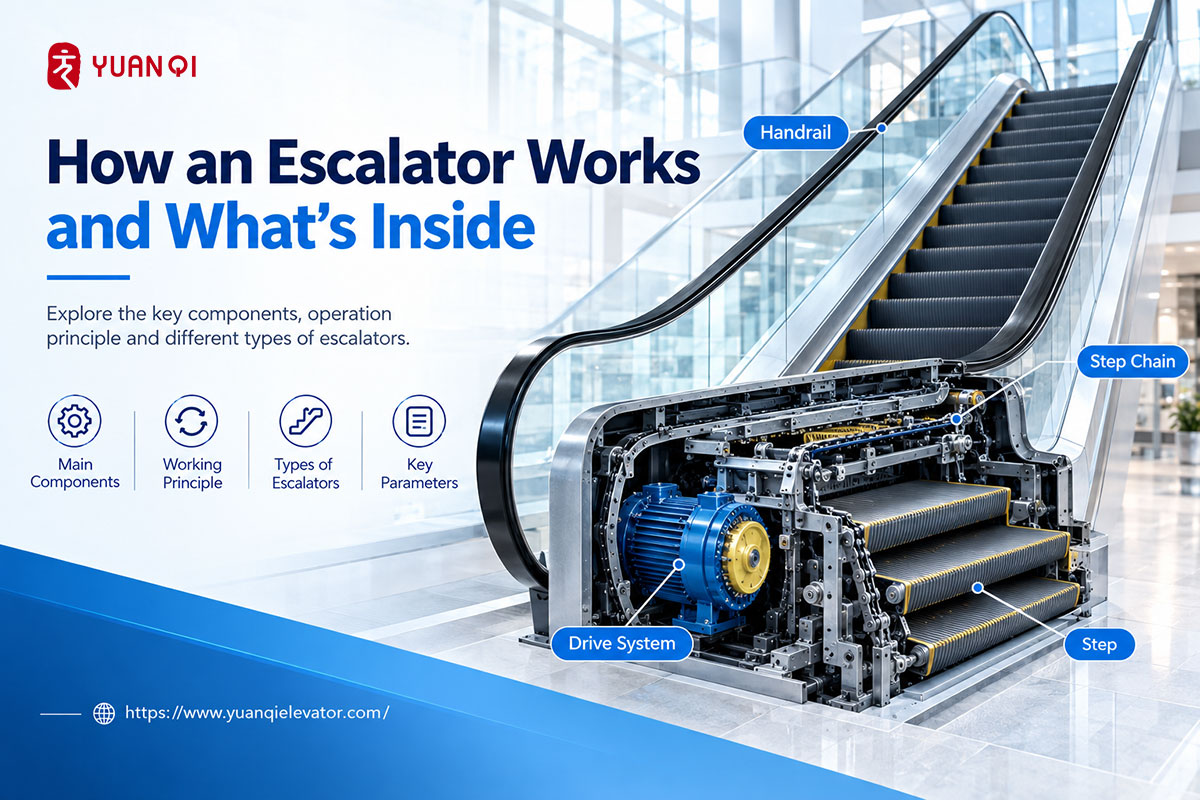
1. Main Components Inside an Escalator
Step Chain and Drive System
The step chain is a key part of the escalator’s traction system. It circulates around sprockets and moves the connected steps along the escalator’s travel path. The drive system supplies the mechanical power required for continuous operation.
Steps and Guide Tracks
Each step is equipped with two sets of wheels that follow separate tracks. One set is connected to the step chain, while the other follows a separate guide track. The relationship between these tracks helps keep the steps level along the inclined section and guides them through the transitions at the landings.
The grooved surfaces of adjacent steps are designed to interlock during the transition, helping form a flatter boarding and exit area.
Moving Handrails
The handrail is a continuous rubber belt that circulates around a series of rollers. It moves in coordination with the steps to provide passengers with a moving handhold throughout the journey.
Structural Truss
The truss is the main supporting framework extending between floors. It houses and supports the drive system, chain mechanism, guide tracks and other internal components.
2. How Does an Escalator Work?
An escalator operates through the coordinated movement of its drive system, step chain, guide tracks and handrails.
Power transmission: The motor drives the transmission system and sprockets, causing the step chain to circulate.
Step movement: The chain pulls the connected steps along the guide tracks.
Maintaining step position: Two sets of wheels follow separate tracks, guiding the steps and keeping them level along the inclined section.
Landing transition: At the top and bottom, the tracks guide the steps through a transition into a flatter arrangement for passenger entry and exit.
Handrail movement: A separate belt-and-roller arrangement moves the handrails in coordination with the steps.
The continuous circulation of these components allows an escalator to transport passengers without stopping after each person reaches the next floor.
3. Common Escalator Types
Escalators can be classified according to several structural and design characteristics.
By Handrail Appearance
Fully transparent handrail design: Uses transparent tempered glass to support the handrail.
Semi-transparent handrail design: Combines translucent tempered glass with a limited number of support posts.
Opaque handrail design: Uses supporting brackets covered with opaque panels.
By Step-Path Shape
Straight escalator: The step path follows a straight inclined route.
Spiral escalator: The step path follows a spiral configuration.
By Traction Mechanism and Drive Location
End-drive escalator: The drive unit is located near the head of the escalator, with a chain serving as the traction element.
Intermediate-drive escalator: The drive unit is positioned within the escalator’s intermediate section. The source material describes this configuration as a rack-driven design.
Multi-drive escalator: Multiple drive units are combined in one escalator system.
These classifications describe different design approaches. The actual configuration depends on the escalator model and its engineering requirements.
4. Key Escalator Technical Parameters
The source material lists the following typical parameters:
|
Parameter |
Values stated in the source |
| Lifting height | Generally within 10 m; special installations may reach several tens of metres |
| Inclination angle | Typically 30° or 35° |
| Rated speed | Commonly 0.5 m/s; some models reach 0.65 m/s or 0.75 m/s |
| Step width | 600 mm, 800 mm or 1,000 mm |
| Theoretical transport capacity at 0.5 m/s | 4,500, 6,750 or 9,000 passengers per hour, respectively, for the listed step-width options |
| Other design parameters | Step pitch and step-chain pitch |
These figures are general reference values from the source material, not specifications for every escalator. Actual parameters should be confirmed against the relevant manufacturer’s documentation and model specifications.
5. Escalators and Moving Walkways
Escalators and moving walkways both provide continuous passenger transportation, but their moving surfaces differ.
The source material identifies three moving-walkway configurations:
Step-type moving walkway: Uses a series of steps and moving handrails.
Steel-belt moving walkway: Uses a steel belt covered with a rubber layer to form the moving surface.
Dual-path moving walkway: Uses a closed-loop arrangement with two paths moving in opposite directions.
The appropriate configuration depends on the building layout, travel distance and intended passenger flow.
Conclusion
An escalator relies on the coordinated operation of its drive system, step chain, guide tracks, steps and moving handrails. Each component contributes to the continuous movement of passengers between floor levels.
Understanding these internal mechanisms and key technical parameters provides a useful foundation for escalator selection, component identification and general equipment knowledge.
WhatsApp: 8618192988423
E-mail: yqwebsite@eastelevator.cn
Post time: Oct-19-2026