

In today’s elevator industry, steel belts have become a preferred alternative to traditional wire ropes—especially in machine-room-less (MRL) and high-efficiency systems. For B2B buyers, selecting the right elevator steel belt is not just about specifications, but about ensuring long-term safety, stability, and cost control.
1. Start with Elevator System Requirements
Every selection begins with matching the belt to the elevator’s working conditions:
Rated load (kg)
Speed (m/s)
Travel height (m)
Sheave diameter (mm)
Higher load and longer travel typically require stronger belts with more steel cords, while smaller sheave diameters demand better flexibility and bending performance.
2. Understand Steel Belt Construction
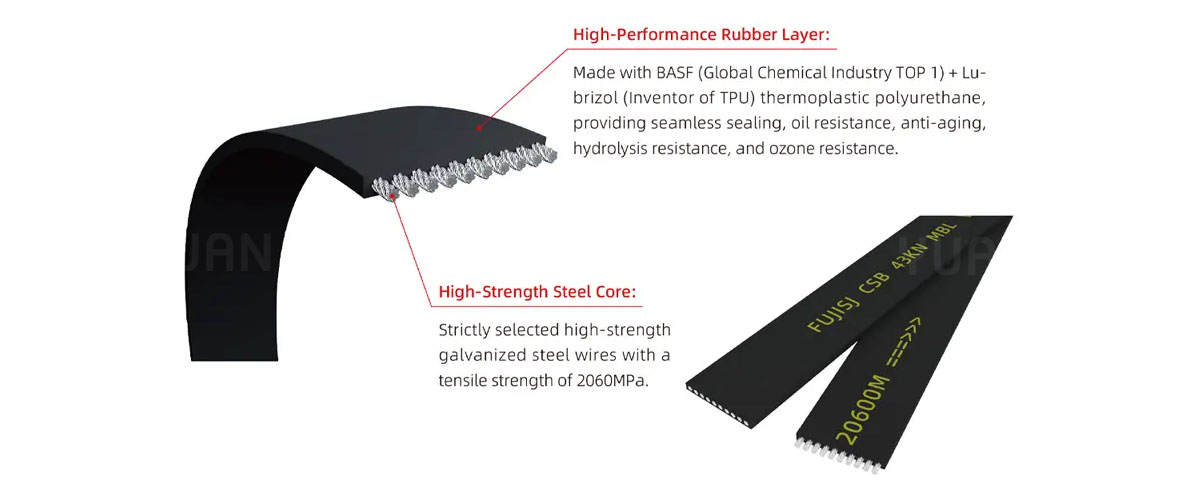
A standard elevator steel belt is a composite structure:
Internal: high-strength steel cords (load-bearing)
External: polyurethane (PU) coating (protection and traction)
High-quality bonding prevents delamination, while durable PU improves wear resistance and maintains consistent traction over time.
3. Check Core Technical Parameters
When comparing different suppliers, focus on measurable technical data:
Parameter Importance
Tensile strength Determines load capacity
Belt width & thickness Affects system compatibility
Number of steel cords Impacts strength and redundancy
Weight per meter Influences efficiency
Minimum bending diameter Critical for small sheave systems
Higher tensile strength is required for heavy-duty applications, while high-speed systems place more emphasis on fatigue performance. Compact designs require thinner and more flexible belts.
4. Evaluate Fatigue Life
Steel belts operate under continuous bending cycles as they pass over traction sheaves. Fatigue resistance directly affects service life and maintenance frequency.
A reliable steel belt should withstand long-term cyclic stress without internal wire breakage, surface cracking, or layer separation. This ensures consistent performance throughout the elevator’s lifecycle.
5. Consider Traction Performance
Stable traction is essential for smooth and safe operation. The belt should maintain a consistent friction coefficient under varying conditions such as dust, oil, or humidity.
Poor traction stability can result in slipping, noise, or inaccurate leveling, all of which impact overall system performance.
6. Adapt to Installation Environment
Environmental conditions have a direct impact on belt durability:
Humid or coastal environments require corrosion resistance
Dusty or oily environments require stable friction performance
High-temperature conditions require material stability
Selecting a belt suited to the installation environment helps prevent premature aging and performance degradation.
7. Verify Safety Standards and Consistency
Consistency across production batches is critical in B2B projects. Steel belts should meet standard safety factors (typically ≥12:1) and maintain stable quality in every delivery.
Using mixed brands or inconsistent products within the same system should be avoided to ensure operational safety.
Why Choose FUJISJ Elevator Steel Belt
FUJISJ elevator steel belt offers high tensile strength, strong fatigue resistance, and stable traction performance. It maintains reliable operation under demanding conditions while reducing maintenance frequency and overall lifecycle cost.
For projects that demand consistent performance and durability, FUJISJ elevator steel belt provides a dependable option.
WhatsApp: 8618192988423
E-mail: yqwebsite@eastelevator.cn
Post time: Mar-30-2026