

Selecting the right escalator handrail is not just about appearance—it directly affects safety, durability, and long-term operating costs. For elevator and escalator professionals, understanding key performance parameters helps ensure the handrail matches both equipment requirements and usage conditions.
I. Key Selection Factors
A qualified escalator handrail should meet the following core requirements:
Durability: Resistance to cracking, abrasion, and aging
Friction Performance: Stable coefficient to ensure synchronized movement with steps
Environmental Resistance: Ability to withstand temperature, humidity, and UV exposure
Compatibility: Suitable for different escalator brands and drive systems
Maintenance Cycle: Longer service life reduces replacement frequency and downtime
II. Critical Technical Parameters
When evaluating handrails, the following parameters should be carefully reviewed:
|
Parameter |
Typical Range |
Description |
| Tensile Strength | ≥ 25 MPa | Determines resistance to stretching and deformation |
| Elongation at Break | ≥ 300% | Indicates flexibility and crack resistance |
| Hardness (Shore A) | 65–75 | Affects grip feel and wear resistance |
| Coefficient of Friction | 0.3–0.6 | Ensures synchronization with step speed |
| Operating Temperature | -20°C to +60°C | Suitable for indoor and semi-outdoor environments |
| Wear Resistance | ≤ 120 mm³ | Lower value indicates better abrasion resistance |
| UV Resistance | ≥ 500 h (no cracking) | Important for outdoor escalators |
| Service Life | 3–5 years (standard) | Depends on usage frequency and environment |
II. Structural Composition
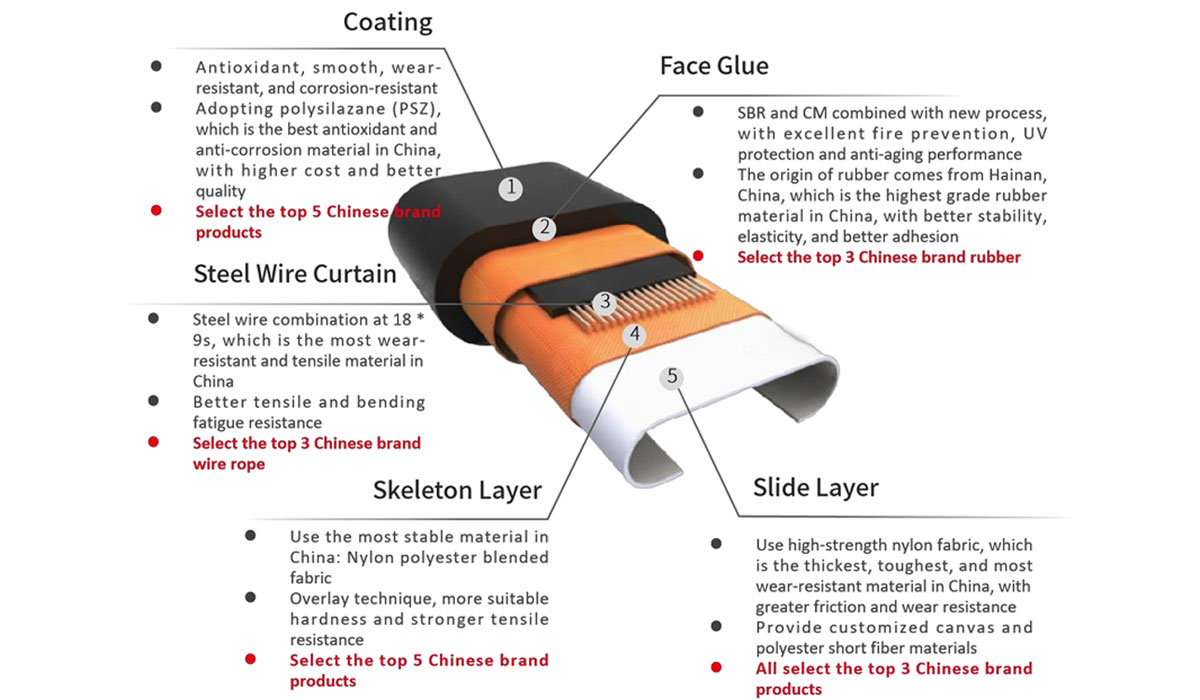
A high-quality escalator handrail is typically made of multiple layers:
|
Layer |
Material |
Function |
| Outer Layer | Rubber / TPU | Provides grip, wear resistance, and appearance |
| Reinforcement Layer | Steel cords / fabric | Ensures tensile strength and dimensional stability |
| Inner Layer | Fabric + rubber | Reduces friction with guide rails |
IV. Matching with Escalator Systems
Different escalator brands may have specific requirements for handrail dimensions and performance. When selecting, consider:
Handrail width and thickness compatibility
Drive system type (friction wheel / chain drive)
Speed synchronization accuracy
Installation method and joint type
For modernization projects, always verify original specifications or replace with equivalent or upgraded models.
V. Performance Testing Standards
Reliable suppliers provide handrails that meet international testing standards:
|
Test Item |
Standard |
Requirement |
| Crack Resistance Test | ISO / EN standards | No cracks after repeated flexing |
| Fatigue Test | ≥ 100,000 cycles | No structural failure |
| Adhesion Strength | ≥ 4 N/mm | Strong bonding between layers |
| Fire Resistance | EN115 / ISO | Meets escalator safety regulations |
VI. Cost vs. Lifecycle Value
While lower-cost handrails may reduce initial expenses, they often result in:
Frequent replacements
Increased maintenance labor
Higher downtime risk
A high-performance handrail with extended durability provides better total lifecycle value, especially in high-traffic environments such as malls, metro stations, and airports.
VII. Recommended Solution
For projects requiring enhanced durability and reduced maintenance frequency, a premium-grade solution is recommended:
FUJI Escalator Handrail Belt — Super durability with 200,000 times of crack-free use
Compared to standard products (typically 100,000 cycles), this significantly extends service life, making it ideal for high-load applications.
Choosing the right escalator handrail requires a balance of mechanical performance, environmental adaptability, and long-term cost efficiency. By focusing on measurable parameters and verified testing standards, you can ensure reliable operation and improved passenger safety.
Post time: Mar-20-2026