

On KONE 501-B escalators, thermal protection faults can be associated with motor temperature or the motor thermistor circuit. Error codes 51–56 cover overheating, interruption, and short-circuit conditions involving Motor 1 and Motor 2.
Identifying the specific fault code helps maintenance personnel determine which motor circuit, wiring connection, or EMB control board parameter requires inspection.
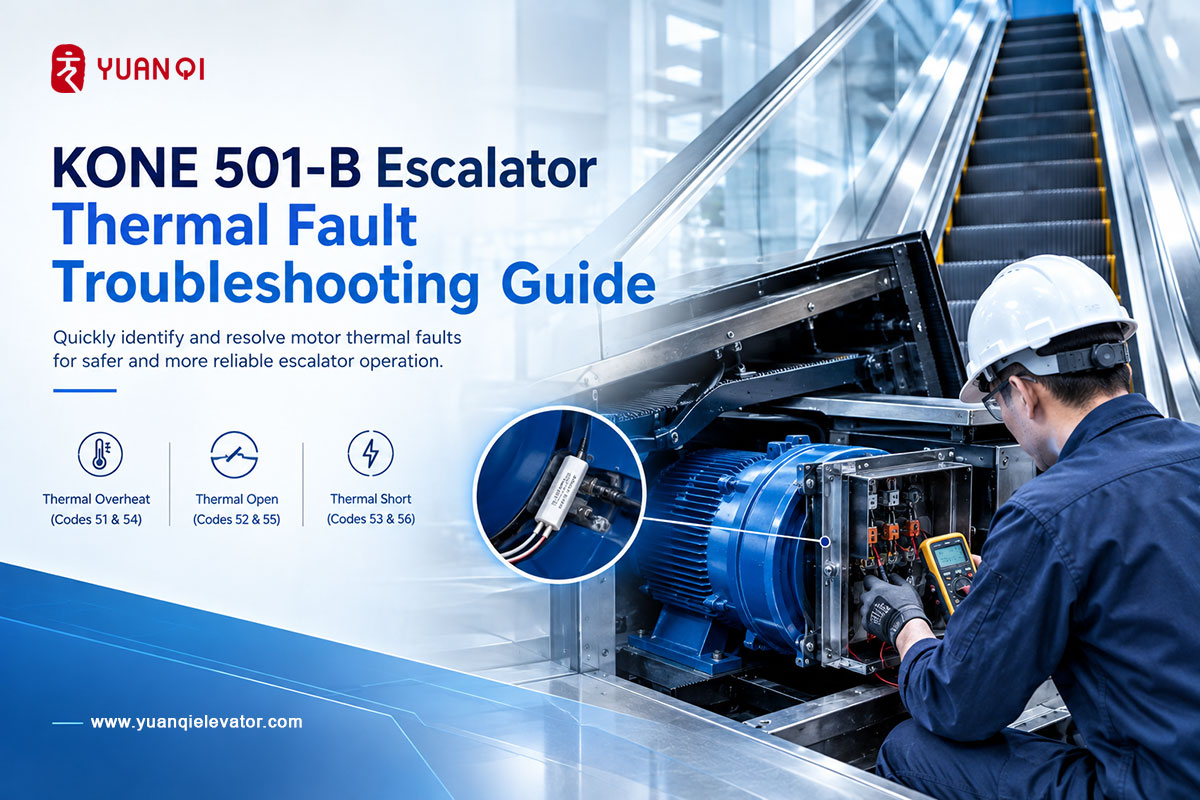
The following guide organizes the troubleshooting procedures according to the supplied technical reference.
1. Error Codes 51–53: Motor 2 Thermistor Faults
Error Code 51: Motor 2 Thermistor Temperature Too High
Possible condition: The Motor 2 thermistor circuit indicates an excessively high motor temperature.
Long periods of repeatedly starting and stopping the escalator using the inspection switch can cause motor overheating. Avoid unnecessary repeated starting operations. For outdoor escalators with motors installed in the upper machine room, ventilation and heat dissipation should receive additional attention during hot weather.
Troubleshooting procedure:
Restart the control cabinet power and press the reset button.
If the fault clears and the escalator returns to normal operation, investigate the cause of motor heating to prevent recurrence.
If the fault remains, switch off the control cabinet power. Disconnect the relevant wiring plug from the EMB board and measure the resistance between terminals X1.41 and X1.50.
If the resistance exceeds 2,800 Ω, the reference procedure identifies excessive motor temperature as a possible cause. Wait approximately 5–10 minutes and check whether the fault clears.
If the resistance is approximately 120 Ω, the motor is not overheating, and the fault remains, the supplied procedure recommends replacing the EMB board.
If the escalator has no second motor, check the parameters associated with code 51 under the EMB board’s FC option. All relevant parameters should be set to 00. If they are already set to 00 and the fault remains, the reference recommends replacing the EMB board.
Error Code 52: Motor 2 Thermistor Interruption
Possible condition: An interruption is detected in the Motor 2 thermistor circuit.
Troubleshooting procedure:
Restart the control cabinet power and press reset.
If the fault clears, inspect the thermistor wiring for loose connections or damaged cables.
If the fault remains, switch off the control cabinet power. Remove the motor terminal box cover and disconnect the thermistor wiring running to the control cabinet. Measure the thermistor resistance.
If the thermistor resistance is normal, the wiring between the motor thermistor and the EMB board may be faulty. If the circuit is open, the supplied procedure indicates that the thermistor has failed and recommends replacing the motor.
If the resistance measured between X1.41 and X1.50 is approximately 120 Ω, the motor shows no signs of overheating, and the fault remains, the reference recommends replacing the EMB board.
If there is no second motor, check the parameters for code 52 under the EMB board’s FC option. All relevant parameters should be set to 00. If the fault persists with these settings, the reference recommends replacing the EMB board.
Error Code 53: Motor 2 Thermistor Short Circuit
Possible condition: A short circuit is detected in the Motor 2 thermistor circuit.
Troubleshooting procedure:
Restart the control cabinet power and press reset.
If the fault clears, inspect the wiring between X1.41 and X1.50 for a short circuit.
If the fault remains, switch off the control cabinet power. Remove the motor terminal box cover, disconnect the thermistor wiring to the control cabinet, and measure the resistance.
If the resistance is normal, investigate the wiring between the thermistor and the EMB board. If the measured resistance is 0 Ω, the supplied procedure identifies a failed thermistor and recommends replacing the motor.
If the wiring and resistance between X1.41 and X1.50 are normal, approximately 120 Ω, and the motor shows no signs of overheating, the reference recommends replacing the EMB board.
If there is no second motor, check the parameters for code 53 under the EMB board’s FC option. All relevant parameters should be set to 00. If the fault remains, the reference recommends replacing the EMB board.
2. Error Codes 54–56: Motor 1 Thermistor Faults
Error Code 54: Motor 1 Thermistor Temperature Too High
Possible condition: The Motor 1 thermistor circuit indicates an excessively high motor temperature.
Troubleshooting procedure:
Restart the control cabinet power and press reset.
If the fault clears and the escalator operates normally, investigate the cause of motor heating to prevent the same fault from recurring.
If the fault remains, switch off the control cabinet power. Disconnect the wiring plug from the EMB board and measure the resistance between terminals X1.40 and X1.50.
If the resistance exceeds 2,800 Ω, the reference identifies excessive motor temperature as a possible cause. Wait approximately 5–10 minutes and check whether the fault clears.
If the resistance is approximately 120 Ω, the motor shows no signs of overheating, and the fault remains, the supplied procedure recommends replacing the EMB board.
Error Code 55: Motor 1 Thermistor Interruption
Possible condition: An interruption is detected in the Motor 1 thermistor circuit.
Troubleshooting procedure:
Restart the control cabinet power and press reset.
If the fault clears, inspect the thermistor wiring for loose connections or damage.
If the fault remains, switch off the control cabinet power. Remove the motor terminal box cover, disconnect the thermistor wiring to the control cabinet, and measure the resistance.
If the thermistor resistance is normal, investigate the wiring between the thermistor and the EMB board. If the circuit is open, the supplied procedure indicates a failed thermistor and recommends replacing the motor.
If the resistance between X1.40 and X1.50 is approximately 120 Ω, the motor shows no signs of overheating, and the fault remains, the reference recommends replacing the EMB board.
Error Code 56: Motor 1 Thermistor Short Circuit
Possible condition: The Motor 1 thermistor circuit is reported as short-circuited.
The available reference begins the following procedure:
Restart the control cabinet power and press reset.
If the fault clears, inspect the wiring between X1.40 and X1.50 for a short circuit.
If the fault remains, switch off the control cabinet power, remove the motor terminal box cover, disconnect the thermistor wiring to the control cabinet, and measure the resistance.
Note: The supplied document ends before the complete troubleshooting procedure for Error Code 56 is available. The remaining diagnostic steps have therefore not been added.
3. Key Inspection Points
When investigating KONE 501-B escalator thermal faults, the supplied reference highlights several important inspection areas:
Motor temperature: Check whether the motor is overheating and investigate possible causes.
Thermistor wiring: Look for loose connections, damaged cables, open circuits, and short circuits.
Resistance measurements: Use the specified terminals for the motor concerned and compare the measured resistance with the values in the reference.
EMB board: If the wiring, resistance, and motor condition are normal but the fault remains, the reference identifies the EMB board as a possible replacement item.
FC parameters: For Error Codes 51–53 on installations without a second motor, check the corresponding EMB board FC parameters and confirm that the relevant values are set to 00.
Conclusion
KONE 501-B escalator Error Codes 51–56 relate to thermistor temperature, interruption, or short-circuit conditions affecting Motor 1 or Motor 2. Correctly identifying the code and motor circuit is an important first step in troubleshooting.
The procedures and measurements in this article follow the supplied technical reference. Actual diagnosis and component replacement should be carried out by qualified escalator maintenance personnel using the applicable equipment documentation and site safety procedures.
WhatsApp: 8618192988423
E-mail: yqwebsite@eastelevator.cn
Post time: Oct-12-2026