

The OTIS OH-CON4424MRL Emergency Rescue Device is used during elevator emergency rescue operations. The device provides indicator signals that allow maintenance personnel to monitor important elevator conditions during the rescue process.
Understanding the indicator signals and the basic operating sequence is important when carrying out emergency rescue procedures for an elevator equipped with the OH-CON4424MRL system.
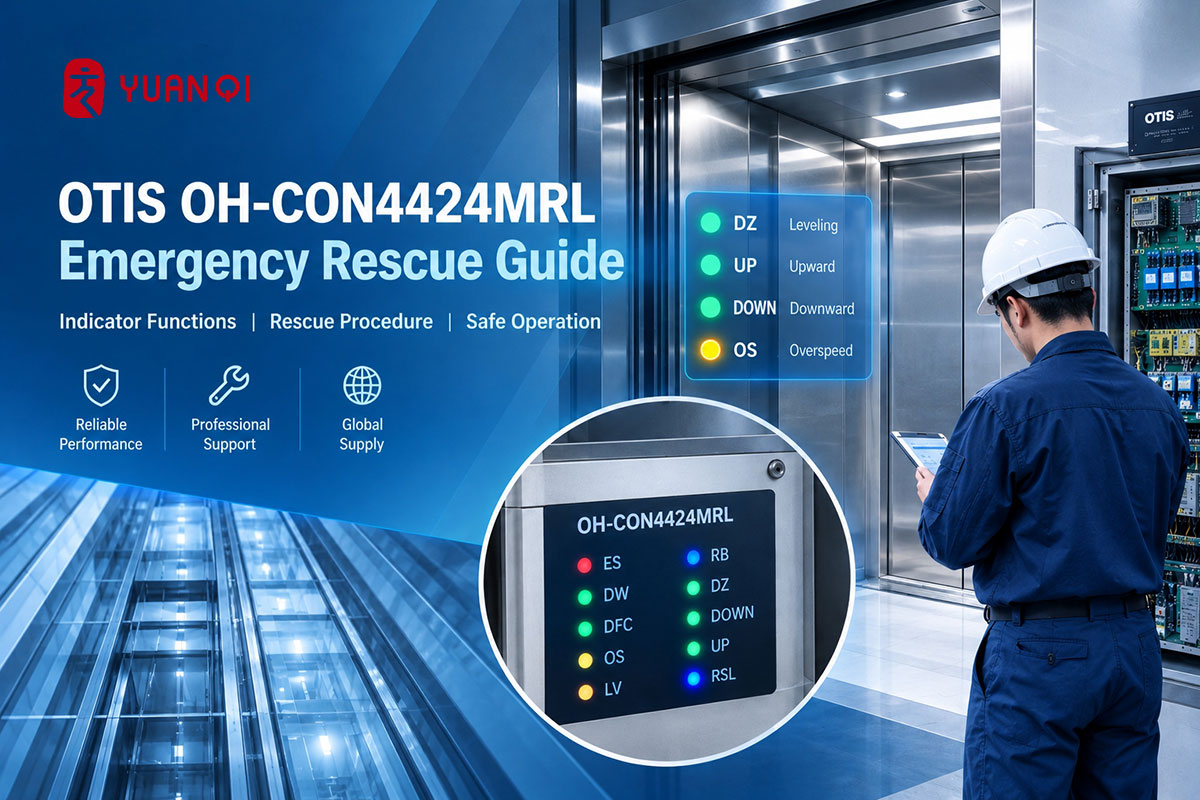
OH-CON4424MRL Indicator Light Functions
The indicator area provides several signals related to elevator status:
|
Indicator |
Meaning |
| ES | Emergency stop status |
| DW | Car door closed |
| DFC | Door lock and safety chain closed |
| OS | Elevator overspeed during brake-release operation |
| LV | Brake-release power undervoltage |
| RB | Brake-release device operating |
| DZ | Leveling signal during normal or brake-release operation |
| DOWN | Downward movement during normal or brake-release operation |
| UP | Upward movement during normal or brake-release operation |
| RSL | Serial communication normal |
These indicators provide visual information during the rescue procedure and are particularly important when monitoring the elevator during brake-release operation.
OH-CON4424MRL Emergency Rescue Procedure
The supplied procedure begins by communicating with the passengers and confirming that rescue work is underway.
1. Communicate with Passengers
Reassure the passengers and inform them that rescue operations are in progress.
2. Confirm the Emergency Condition
The emergency rescue procedure applies when the elevator has lost power or when ERO rescue is ineffective.
3. Turn Off and Lock the Main Power
Before emergency rescue, turn off the main power supply and lock it. The supplied instructions specify that this should also be done when the elevator has already lost power.
4. Check the Elevator Position
Before performing emergency rescue, check the DZ leveling indicator to determine whether the elevator car is within the leveling position.
If the car is already at the leveling position, confirm the floor where the car is located and proceed to open the landing door and car door for passenger rescue.
5. Rescue the Elevator from a Non-Leveling Position
If the elevator is outside the door zone, first verify the operation of the “Brake Release 2” brake-release key switch.
Turn the key switch 90 degrees to the right and release it within one second. The car should remain stationary. This confirms that the switch function is effective.
After verification, turn the “Brake Release 2” key switch 90 degrees to the right and keep it in this position throughout the rescue operation.
Then momentarily operate the “Brake Release 1” brake-release button.
If the car begins to move, the UP or DOWN indicator will illuminate, showing the direction of movement. Continue monitoring the elevator until the DZ leveling indicator illuminates, indicating that the car has reached the leveling position.
Once the car reaches the leveling position, release the “Brake Release 1” button and the “Brake Release 2” key switch, then go to the corresponding floor and open the landing door and car door.
Monitor the Elevator During Brake Release
During the brake-release process, the elevator movement and the DOWN, UP, and OS indicators should be closely monitored.
The purpose is to confirm the direction of car movement and observe whether an overspeed condition occurs during the rescue operation.
Key Points of the OH-CON4424MRL Rescue Process
The basic sequence described in the supplied material can be summarized as:
Passenger communication → Power isolation → Check DZ → Verify brake-release switch → Brake-release operation → Monitor UP/DOWN/OS → Reach leveling position → Release controls → Open doors
The DZ indicator is particularly important because it is used to determine whether the car has reached the leveling position during the rescue process.
Important Safety Note
Emergency elevator rescue involves electrical, mechanical, and safety-related systems. The procedure described above is based on the supplied OH-CON4424MRL service information. Actual rescue work should be performed by qualified elevator personnel following the applicable elevator service documentation and site safety requirements.
WhatsApp: 8618192988423
E-mail: yqwebsite@eastelevator.cn
Post time: Sep-17-2026