

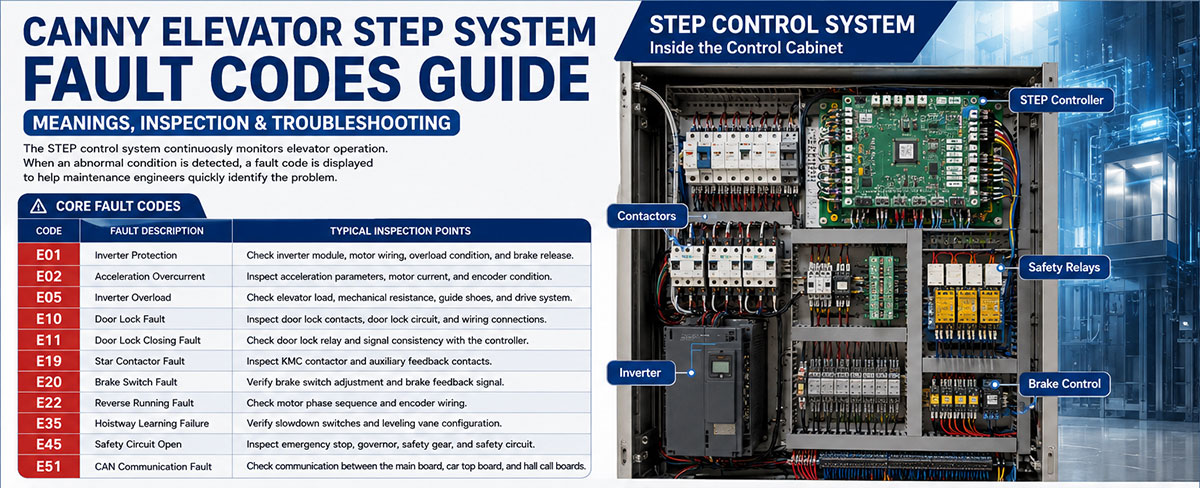
The STEP control system is widely used in Canny elevators and is known for its stable performance and intelligent control. During daily operation, the controller continuously monitors the elevator’s electrical and mechanical systems. When an abnormal condition is detected, a fault code is displayed to help maintenance engineers quickly identify the problem.
This guide explains the most common STEP system fault codes, practical inspection methods, and troubleshooting tips.
Common STEP System Fault Codes
|
Code |
Fault Description |
Typical Inspection Points |
| E01 | Inverter Protection | Check inverter module, motor wiring, overload condition, and brake release. |
| E02 | Acceleration Overcurrent | Inspect acceleration parameters, motor current, and encoder condition. |
| E05 | Inverter Overload | Check elevator load, mechanical resistance, guide shoes, and drive system. |
| E10 | Door Lock Fault | Inspect door lock contacts, door lock circuit, and wiring connections. |
| E11 | Door Lock Closing Fault | Check door lock relay and signal consistency with the controller. |
| E19 | Star Contactor Fault | Inspect KMC contactor and auxiliary feedback contacts. |
| E20 | Brake Switch Fault | Verify brake switch adjustment and brake feedback signal. |
| E22 | Reverse Running Fault | Check motor phase sequence and encoder wiring. |
| E35 | Hoistway Learning Failure | Verify slowdown switches and leveling vane configuration. |
| E45 | Safety Circuit Open | Inspect emergency stop, governor, safety gear, and safety circuit. |
| E51 | CAN Communication Fault | Check communication between the main board, car top board, and hall call boards. |
Three-Step Troubleshooting Method
When a fault code appears on the controller, following a systematic inspection process can significantly reduce troubleshooting time.
Step 1 – Static Inspection
Begin by checking the controller indicators.
Input Indicators (X)
For faults such as E10 (Door Lock Fault), verify whether the corresponding input indicator (such as X6) changes correctly when the door lock operates.
Output Indicators (Y)
If the elevator does not start, check whether the controller outputs are functioning properly, especially:
- · Y0 – Main Contactor
- · Y1 – Brake Output
Missing output signals may indicate a control or safety circuit problem.
Step 2 – Dynamic Inspection
Use the handheld operator or maintenance tool to monitor the controller in real time.
Important monitoring items include:
Run State
Check whether the controller recognizes the elevator as:
- · Automatic Mode
- · Inspection Mode
- · Fault Mode
Input / Output Monitoring
Observe signal changes while manually operating doors or switches.
For example, verify that the door-open limit signal changes correctly when the door reaches its fully open position.
Step 3 – Encoder Verification
The STEP system relies heavily on accurate encoder feedback.
If faults such as E30 (Encoder Deviation) or E31 (Motor Stall) occur, inspect the following:
- · Encoder cable shielding (single-end grounding recommended)
- · Loose encoder mounting brackets
- · Shaft slippage
- · Electrical interference
Correct encoder installation is essential for stable speed control and accurate leveling.
Common Maintenance Cases
Elevator Stops at the Top or Bottom Floor
If the elevator refuses to move after reaching the terminal floor, inspect the X0 and X1 forced slowdown switches.
A damaged or continuously activated slowdown switch may keep the controller in protection mode.
Frequent E51 CAN Communication Fault
Repeated communication faults are commonly caused by unstable power or damaged communication wiring.
Inspect:
- · 24V power supply on the car-top board
- · CAN+ and CAN− communication cables
- · Traveling cable condition
- · Connector terminals
Replacing damaged communication cables often resolves intermittent E51 faults.
Poor Leveling Accuracy
If the elevator does not level accurately, inspect the leveling sensors.
For many Canny elevators, photoelectric leveling sensors are used.
Common causes include:
- · Dust contamination
- · Misaligned leveling vane
- · Loose mounting brackets
- · Sensor aging
Cleaning or realigning the sensor usually restores accurate leveling.
Preventive Maintenance Recommendations
Routine inspection helps reduce unexpected shutdowns and extends equipment life.
Maintenance engineers should regularly inspect:
- · Door lock circuits
- · Brake switches
- · Encoder connections
- · CAN communication wiring
- · Main contactors
- · Safety circuits
- · Leveling sensors
- · Forced slowdown switches
- · Guide shoes and mechanical resistance
Preventive maintenance can greatly improve elevator reliability and reduce service interruptions.
Understanding STEP system fault codes allows maintenance engineers to diagnose problems more quickly and accurately. Combined with systematic inspection procedures and regular preventive maintenance, proper fault analysis helps ensure safe, reliable, and efficient elevator operation.
Whether you need Canny elevator spare parts, STEP control system components, or elevator modernization solutions, YuanQi offers high-quality products, professional technical support, and one-stop services for customers worldwide.
WhatsApp: 8618192988423
E-mail: yqwebsite@eastelevator.cn
Post time: Jul-10-2026